How to set Canadian GST, HST, PST, and tire levies in Books?
TB Books · tax · Last updated October 26, 2026 · Version 1
This process works in apps: TB Books, TB POS
This article will teach you how to switch the shop to Canada, edit province tax rules, capture GST numbers on customers, and auto-add EHF tire levies.
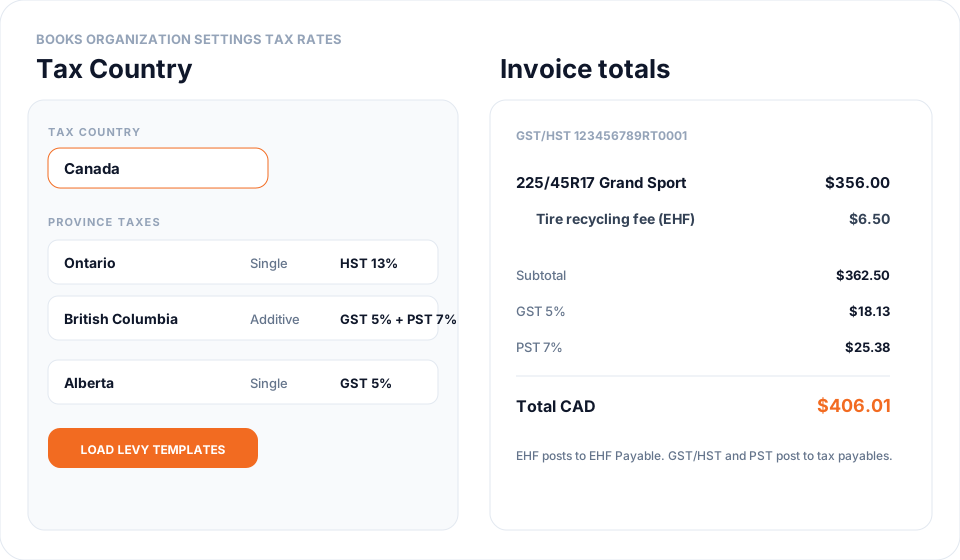
Canadian shops charge GST or HST plus a provincial tax in some provinces, and a separate tire recycling fee (EHF) that is not a tax. Organization Settings → Tax Rates has a Tax Country control. Switching to Canada creates province rates (GST 5%, HST, PST/RST/QST), payable accounts, tire levy fee services, and auto-add rules. Those services and rules stay until you delete them one by one or run Data Migration → Fresh Start. Quotes, work orders, and invoices then pick a province and print GST/HST and PST as separate totals in CAD.
Steps
- Open Organization Settings → Tax Rates. Choose Tax Country → Canada and type CANADA. Tire Base creates the province tax rates, the tire levy fee services, and the auto-add rules. FET on catalog items is zeroed. Those records stay if you switch back. Delete services and rules one by one, or use Data Migration → Fresh Start. Province tax rates stay on this page until you edit them.
- Review Province Taxes. Edit a province row to change GST/HST or PST/RST/QST rates and whether they are Single or Additive. Canada does not use New Tax Rate or Use as default sales tax. Search for Add tax rate, Tax percent, or Default tax rate opens this page. Enter the shop GST/HST (and QST) registration numbers so they print on invoices.
- Set Default province to the shop province, such as Alberta for GST only. New documents use it only when the shop location and the customer do not name a province. It does not lock every sale to that rate, and it does not override a Ship To, the customer’s own province, or a Province Override. Also set that province on the shop under Organization Settings → Locations. A POS work order uses the location province.
- Turn on Prices include tax when the shelf price already includes the tax. A $100 price stays $100, and GST/HST/PST/QST is taken out of that price. Leave it off when tax should be added on top: a $30 line in a GST 5% province is $1.50 tax and a $31.50 total. This switch applies to Books invoices, Books work orders, and POS work orders.
- Load levy templates only adds fee services and auto-add rules that are missing. It does not overwrite a fee you already saved. A fee is added only when the document province matches that fee. Ontario is left blank because each producer sets its own fee. See How to add a Canadian tire levy (EHF or taxe pneu) in Books.
- On a customer, open Canada Tax Settings. Enter GST/HST, PST, QST, or First Nations registry numbers. Check PST/QST exempt, First Nations exempt, or EHF exempt when the customer should skip those charges. Leave Province Override blank unless that customer should always use one province. A filled override wins on Books quotes, work orders, and invoices, including a counter sale.
- A counter sale and a shipped sale use different provinces. In POS, the work order uses the shop location’s province. POS has no Ship To, so the customer’s home address does not change that tax. Open the province list on that work order only when that ticket should use another province. In Books, order type Local stays on the shop province and ignores a ship-to. Other order types use the ship-to province.
- On a Books invoice or quote, the tax picker is a province list. The province is the customer’s Province Override, then the Ship To on that document, then the province on the customer’s own address, then the shop location, then Default province. If the customer has saved locations, the invoice selects the default Ship To, including a walk-in sale. Totals show GST/HST and PST/QST on their own rows, plus EHF as a recycling fee line — never labeled as tax. A GST label with $0.00 means that document has no province yet: set the location province or Default province, or pick the province on the document.
- Open Reports → GST/HST & Provincial Tax for the filing period. GST and HST are the federal section. PST, RST, and QST are a separate section. Sales Tax Liability stays hidden when Tax Country is Canada. See How to run the GST/HST and provincial tax report in Books?.
Conclusion & best practices
Handing the tires to the customer at the shop uses the shop province. Shipping them uses the destination on that invoice. A single default percent, the way a US shop marks Use as default sales tax, cannot split GST from PST or QST and cannot change when the goods are shipped. Canadian tax posts to GST/HST Payable, PST/RST Payable, QST Payable, and EHF Payable instead of sitting in Sales. Keep FET off Canadian tickets. Confirm Nova Scotia HST (14% as of April 2025) and levy amounts with the province before remitting. Input tax credits on bills are not in this release. What the switch creates, and how to remove it, is in What is created when I switch Tax Country to Canada?. Shops use different names for the same taxes — see What do GST, HST, PST, QST, TPS, and TVQ mean in Tire Base?. The per-tire fee is separate — see How to add a Canadian tire levy (EHF or taxe pneu) in Books?.